Build Scalable Video Data Workflows

Process public or authorized video and audio sources through one API and deliver workflow-ready output at scale.

  • Simple integration

    Send one request and let us handle fetching, processing, formatting, and delivery.

  • Built for scale

    Run large-volume video and audio workflows with stable throughput and enterprise-ready performance.

  • Files ready for downstream use

    Deliver video, audio, metadata, and transcripts securely to your storage for analytics, AI, and internal workflows.

BestProxy

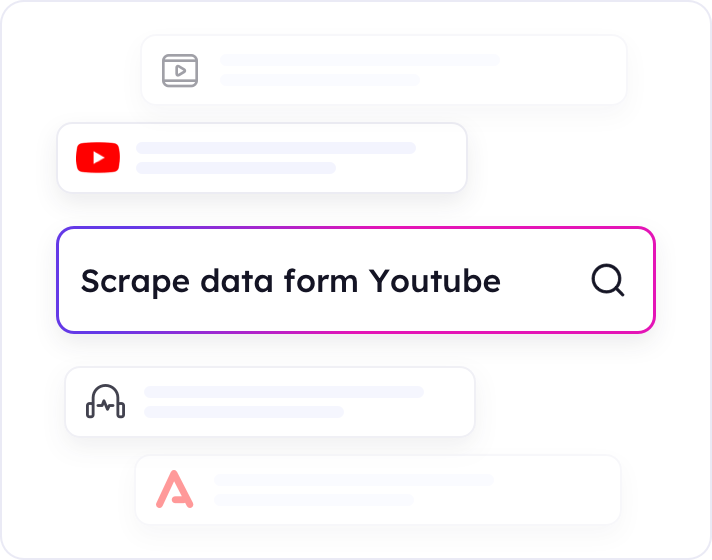
Build AI-ready datasets from YouTube

Power LLM, multimodal, and media analysis workflows with large-scale video and audio collection. Our API automates fetching, processing, and delivery so your team can focus on downstream training and analytics.

BestProxy
Capture speech, visuals, and audio for model training

Collect YouTube video or audio files to enrich datasets for AI training, evaluation, and media research.

BestProxy
Control storage and delivery

Choose output formats and delivery destinations that fit your ingestion and training pipelines.

BestProxy
Cloud delivery made simple

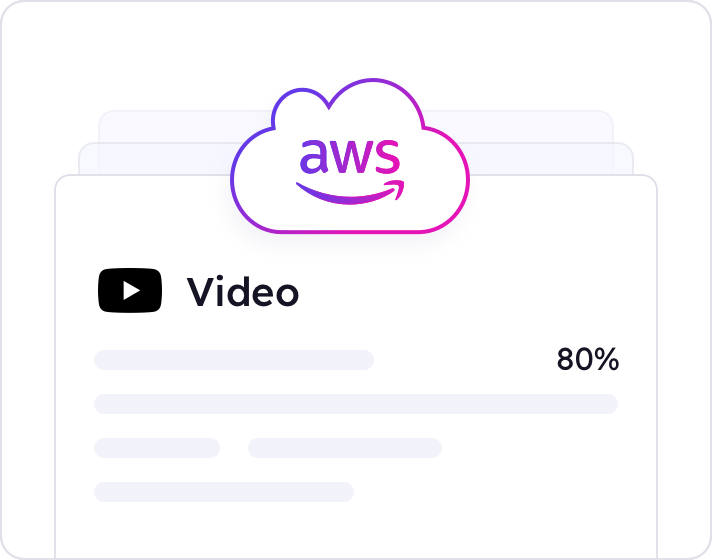
Files move from download to cloud storage automatically, reducing manual handling and operational overhead.

Video and audio collection without the operational burden

Skip the work of building downloaders, managing retries, and handling delivery. Send the video or audio URLs you need and receive workflow-ready output in storage formats suited for AI, analytics, and internal processing.

Start Now
BestProxy

Plug-and-Play API for AI Training Data

Start with compliant, ready-to-use data workflows and cut most of the engineering overhead required to build and maintain an in-house media pipeline.

  • BestProxy
    Minimal infrastructure to maintain

    Reduce development overhead and keep engineering teams focused on downstream products instead of media pipeline upkeep.

  • BestProxy
    Scale to millions of files per day

    Support continuous high-volume YouTube collection and delivery for long-running data workflows.

  • BestProxy
    Cloud-native output delivery

    Deliver files and metadata directly to AWS S3 and other storage environments used for AI and analytics.

How the workflow builds multimodal training datasets

BestProxyBestProxy
BestProxy
BestProxy
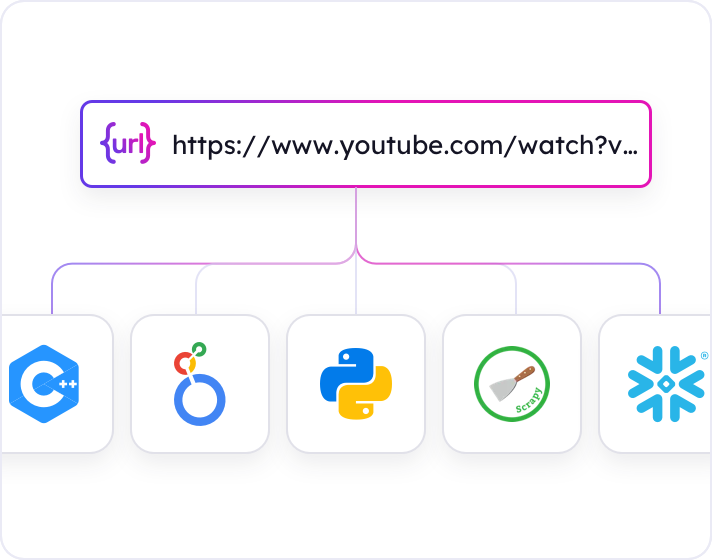
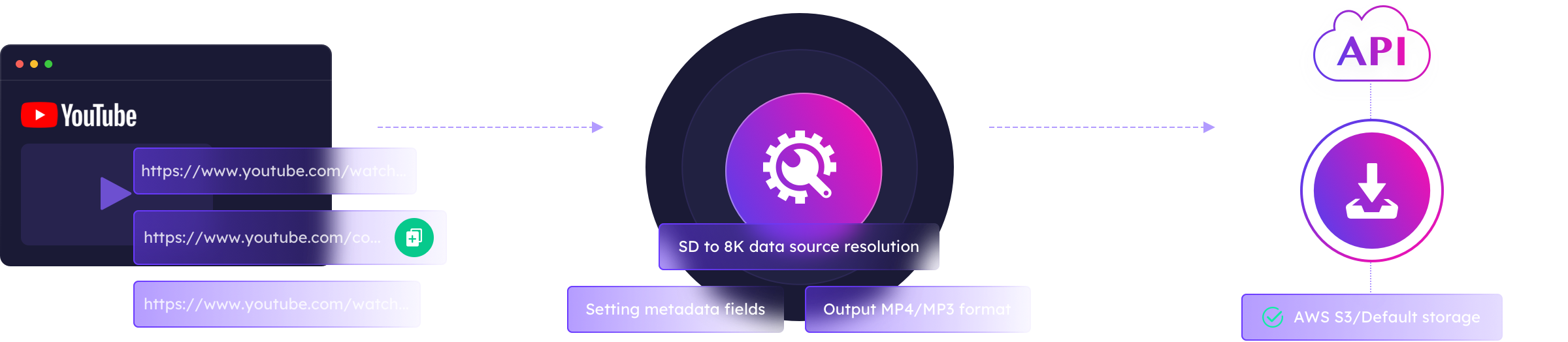
1. Submit video or playlist URLs

Send single or batch YouTube URLs through the API.

2. Configure output parameters

Choose resolution requirements from source-best output to lower-quality variants.

Select metadata fields such as title, description, subtitles, or audio.

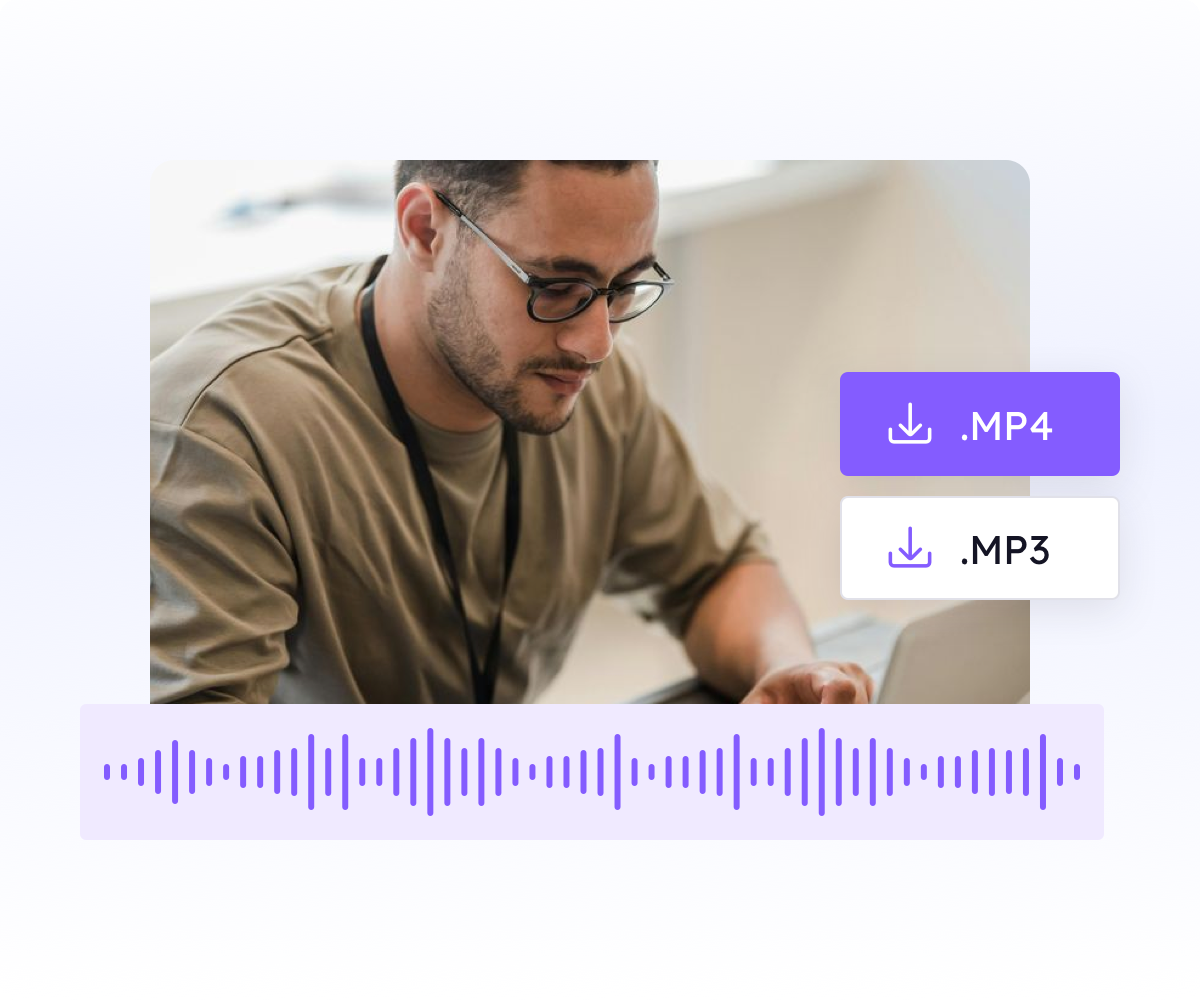
Set the output format, including MP4 or MP3.

3. Process and deliver the files

The API triggers download, processing, validation, and secure delivery.

Track status in real time through the run list.

Store results directly in default storage or AWS S3.

BestProxy

Enterprise automation, end to end: connect download, processing, and delivery workflows through one API integration.

Get the Integration Guide
Pricing

Video Downloader API Plans

Automate large-scale video collection and delivery with pricing built for recurring workflows.

500G
$0.11/GB
Total: $57.00/Month
5T
$0.09/GB
Total: $475.00/Month
20T
$0.08/GB
Total: $1710.00/Month
100T
$0.06/GB
Total: $6650.00/Month

Custom Services Tailored for You

  • BestProxyHigh-quality video downloads
  • BestProxyAutomated batch processing
  • BestProxyTranscript and subtitle extraction
  • BestProxy24/7 technical support
  • BestProxyStructured metadata for ML pipelines
  • BestProxyDirect delivery to cloud storage
  • BestProxyNo proxy or unblocking maintenance
  • BestProxyCustom workflow support
BestProxy

Due to policy restrictions, this service is currently unavailable in mainland China.

We accept the following payment methods:

BestProxy

Secure and Responsible Video Data Access

Built for secure access to public or authorized video data, with restricted-content filtering and protected API infrastructure.

Designed around privacy and security principles:
  • Privacy-aware processing
  • Responsible data collection workflows
  • Protected API infrastructure
BestProxy

Prepare compliant, high-quality datasets for multimodal AI training

A trusted pipeline that processes tens of millions of video metadata records every day

View Pricing

What Our Customers Are Saying

BestProxy user
Trusted by users worldwidedelivering excellence with every product
Get Started
Help Center

Proxy Knowledge Guide

What can I find here?
Provides you with everything you need to get started with our proxy
Support

If you can't find something or need assistance, please contact us at [email protected]

Got Questions?
What Is a Video Downloader API and Who Is It For?
BestProxyBestProxy

A video downloader API is a service that accepts video or playlist requests and returns processed media files, metadata, or delivery outputs through a structured interface. Instead of building and maintaining your own public media handling workflow, you can send requests and receive predictable results in a format your team can use.

This type of API is useful for teams that work with publicly accessible video or audio content at scale and need a stable way to manage collection, processing, and delivery.

1. Research and analytics teams

Teams that study public media trends often need repeatable access to video files, audio tracks, subtitles, or metadata. A video downloader API helps standardize that process and makes it easier to move media into analysis pipelines.

2. AI and multimodal dataset teams

If your team prepares training inputs for speech, vision, or multimodal projects, the API can help organize how public media is retrieved and delivered to storage. That reduces manual handling and keeps input formats more consistent.

3. Media operations teams

Some businesses need a dependable workflow for moving public video assets into review, archiving, or internal processing systems. An API-based approach reduces repeated manual work and makes output handling more predictable.

4. Platform and product teams

If you are building internal tools, dashboards, or automated workflows, a video downloader API can reduce engineering effort at the infrastructure layer. Your team can spend less time managing delivery logic and more time on business workflows.

Conclusion

A video downloader API turns public media handling into a structured integration workflow. For teams that need scalable, organized, and reliable delivery of public video or audio data, it is often a more maintainable option than relying on ad hoc scripts.

Video Downloader API vs Self-Built Workflow: What Changes?
BestProxyBestProxy

Many teams start with scripts for downloading and organizing public media files, but that approach often becomes harder to manage as volume grows. A video downloader API changes the workflow by moving routine processing and delivery steps behind a structured service layer.

The main difference is not only speed. It is about consistency, operational effort, and how easily the workflow can scale across multiple teams or use cases.

1. Less maintenance overhead

With a self-built workflow, your team must maintain request logic, format handling, storage delivery, and job monitoring on its own. With an API, those steps are standardized through one integration path.

2. More predictable output

When multiple scripts evolve over time, output formats can become inconsistent. An API makes it easier to keep media files, metadata, and delivery destinations aligned with a single processing rule set.

3. Easier integration with storage systems

Teams often need media files to move directly into cloud storage or downstream processing queues. A managed API can simplify how files are transferred and reduce the number of manual handoff steps in the workflow.

4. Better fit for shared operations

If research, product, and data teams all rely on the same public media workflow, a central API is easier to govern than separate script collections owned by different people.

Conclusion

A self-built workflow can work for small experiments, but a video downloader API is usually a stronger long-term option when stability, repeatability, and shared operations matter.

What Data Can a Video Downloader API Deliver?
BestProxyBestProxy

A video downloader API can do more than return a raw video file. Depending on the workflow, it may deliver multiple output types that help downstream systems process, index, or analyze public media content more efficiently.

The exact output depends on implementation, but the following categories are the most common.

1. Video files

The API may return processed video assets in selected formats or quality levels. This is useful when teams need standardized media files for review, storage, or model input preparation.

2. Audio files

Some workflows only need the audio portion of a public video source. A video downloader API can support audio-focused delivery for speech analysis, transcription, or downstream indexing.

3. Metadata

Structured metadata often includes fields such as title, description, publish information, duration, and source identifiers. This information is important for search, filtering, audit trails, and content organization.

When available in the workflow, subtitle-related outputs can help teams prepare text-aligned datasets, support content review, or enrich media indexing pipelines.

5. Delivery status and storage results

Operational outputs are just as important as media assets. Many teams need job status, destination details, or delivery confirmation so that internal systems can track completion and trigger the next step.

Conclusion

The value of a video downloader API is not only in retrieving public media. It is also in delivering usable files, metadata, and workflow status in a way that fits production systems.


How Can a Video Downloader API Support AI Training Workflows?
BestProxyBestProxy

AI training workflows often depend on consistent inputs. If your team works with speech, vision, or multimodal tasks, a video downloader API can help standardize how public media assets are collected, processed, and delivered into storage.

The API does not replace dataset design or governance, but it can reduce friction in the operational layer.

1. Standardized media retrieval

Teams preparing training inputs often need a repeatable way to retrieve public video or audio from known sources. An API-based workflow makes that process easier to scale across batches and projects.

2. More consistent file handling

Model preparation usually becomes harder when media assets arrive in mixed formats or inconsistent storage paths. A video downloader API can help keep output organization more uniform across jobs.

3. Metadata alignment for downstream systems

Training workflows often need file assets and metadata to move together. Structured metadata makes it easier to index content, apply filters, and connect media files to annotation or evaluation systems.

4. Direct delivery into storage

When output can move directly into cloud storage or designated repositories, teams spend less time on manual transfers and reduce the risk of broken handoff steps in the pipeline.

Conclusion

A video downloader API can support AI training workflows by making public media handling more structured, repeatable, and easier to integrate with dataset preparation systems.

Is a Video Downloader API a Good Fit for Secure Media Workflows?
BestProxyBestProxy

Security and operational control matter when teams work with public media at scale. A video downloader API can be a strong fit for secure media workflows because it gives teams a more structured way to manage requests, output handling, and delivery operations.

The value is not only technical. It is also about reducing scattered processes and creating clearer workflow boundaries.

1. Controlled processing flow

When public media requests move through one standardized API path, it becomes easier to define how jobs are submitted, how results are returned, and how files move into storage.

2. Better support for internal governance

Security-minded teams usually need clearer operational rules around data handling, storage destinations, and workflow permissions. A centralized API can support more consistent governance than disconnected scripts.

3. Lower manual handling risk

Every manual step in a media workflow creates more room for inconsistency. Standardized delivery reduces repeated handoffs and helps teams build more dependable internal processes.

4. Stronger fit for shared enterprise operations

If multiple departments depend on the same media workflow, a managed API is easier to review, document, and operate than separate local tools spread across teams.

Conclusion

A video downloader API is often a practical fit for secure media workflows because it helps teams organize processing, delivery, and internal control around one repeatable interface.

View All FAQs
BestProxy
BestProxyBestProxy