






DuckDuckGo Search API
Access live DuckDuckGo search results with BestProxy DuckDuckGo SERP API. Retrieve privacy-focused search result data without building your own scraping stack.


Test DuckDuckGo search data extraction without maintaining browser automation, proxy routing, or retry systems.

Expand your coverage beyond mainstream engines and compare how DuckDuckGo presents rankings, snippets, and result layouts.

Skip the work of running a custom scraper for DuckDuckGo and rely on a managed API pipeline for reliable delivery.

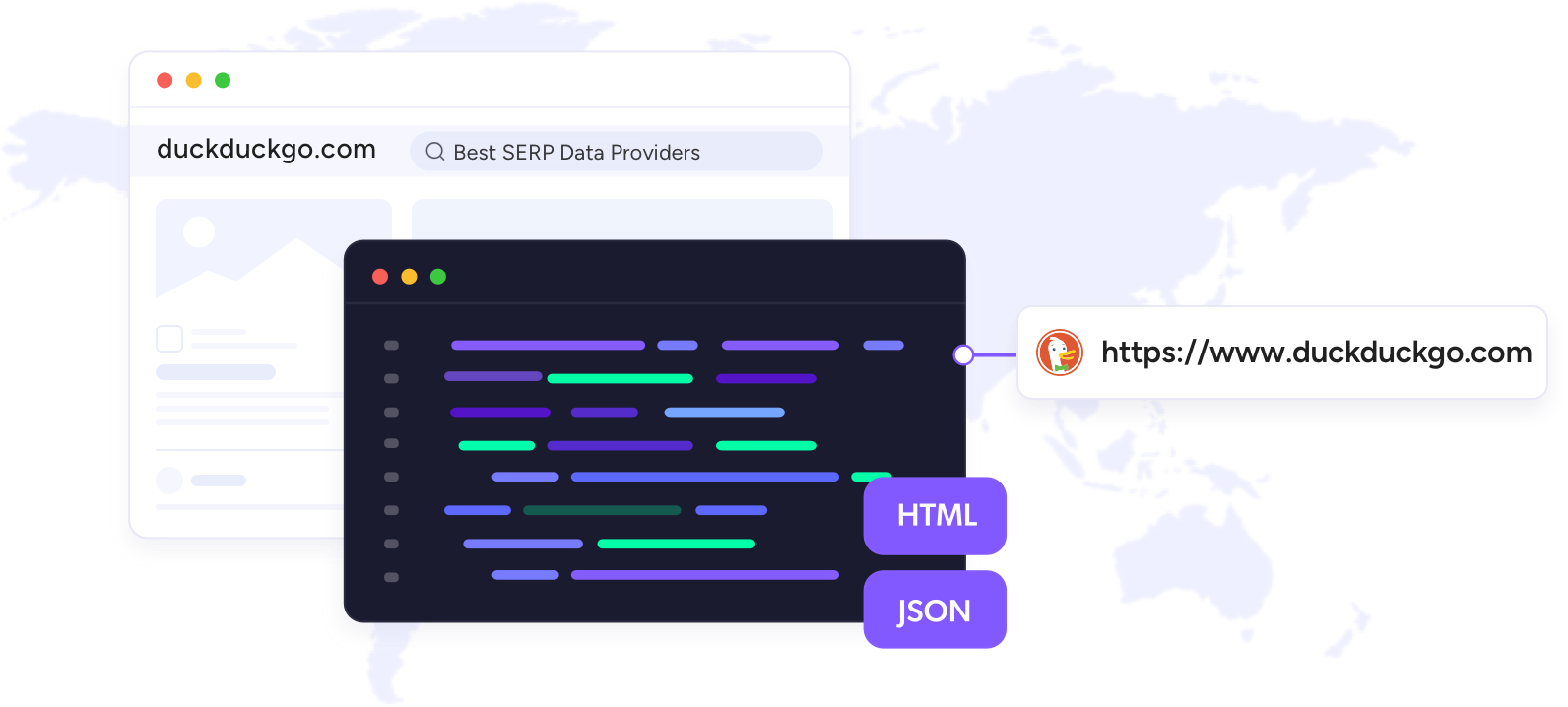
Receive structured JSON or HTML that fits reporting pipelines, SEO analysis, and internal search intelligence tools.
Pull DuckDuckGo SERP data when needed and pay only for successful requests.
Due to policy, this service is not available in mainland China.
We accept these payment methods:

Proxy Knowledge Guide
If you can't find something or need assistance, please contact us at [email protected]
A SERP API is a service built for collecting search engine results page data through a structured interface. Instead of maintaining your own public web data collection workflow, network access resources, and page parsing logic, you can send standardized requests and receive structured search result data.
This type of service is commonly used by teams that need ongoing access to search result data, especially in the following scenarios.
If you need to track how keywords perform on Google, Bing, Baidu, or other search engines over time, a SERP API is often more stable than manual checks or browser automation. You can collect results by country, city, device, and language, then feed that data into your own reporting workflows to monitor organic rankings, competitor visibility, and search presence over time.
Many advertisers adjust what users see based on region, device context, and search intent. A SERP API can help you collect ad placements, sponsored results, branded query coverage, and regional differences in search result presentation. This makes it useful for ad verification, brand protection, and paid search review workflows.
Teams in ecommerce, SaaS, travel, and local services often need to understand how competitors appear in search results. With a SERP API, you can regularly collect result page data for competitor terms, category terms, and branded queries, then analyze title patterns, landing page strategies, rich result exposure, and ranking shifts.
Search results are not the same everywhere. Results can differ by country, city, language, and device type. For teams operating across multiple markets, localized SERP data is important for understanding regional differences, evaluating local SEO performance, and supporting international content or campaign planning.
If your team is building internal tools, monitoring systems, BI dashboards, or client-facing deliverables, a SERP API can reduce low-level engineering work. Instead of repeatedly rebuilding data collection infrastructure, you can focus more on data cleanup, business rules, and presentation layers.
A SERP API turns search result data collection from an infrastructure problem into an interface workflow. If your business depends on stable, scalable, and structured access to public search result data, it is often a more maintainable option than building the full pipeline yourself.
Many teams initially consider building their own search result data collection pipeline because it appears more controllable. In practice, however, long-term maintenance is often more expensive than expected. The value of a SERP API is not only that it saves development time, but also that it can improve long-term stability and reduce operational overhead.
The difficult part of self-built search data collection is often not the request itself, but the surrounding network workflow, request pacing, regional simulation, and exception handling. A SERP API usually abstracts much of that complexity, so the business side receives standardized data instead of a large amount of inconsistent output.
Search engine result page structures change frequently. HTML parsing logic that works today may require updates later. A self-built solution needs continuous parser maintenance across organic results, ads, local packs, maps, rich results, and other modules. A SERP API often returns structured JSON directly, which can reduce maintenance on the parsing layer.
If you only monitor a small number of keywords in one country, manual or self-built workflows may still be manageable. Once the scope expands to multiple countries, languages, and search engines, complexity rises quickly. A SERP API is usually better suited to this kind of scale because it is designed for parameterized, repeatable requests.
For data platforms, marketing systems, BI workflows, and internal monitoring tools, the most important requirement is often a stable data input. SERP APIs are typically exposed through standard interfaces that can be connected to back-end services, schedulers, and data warehouses more easily than custom browser-based pipelines.
Building internally may seem to avoid API spend, but it still consumes engineering time, operations effort, and ongoing maintenance resources. As usage grows, drops in system stability or data availability can create costs that outweigh the price of using a mature SERP API service.
If your competitive value is in analytics, operations, or product delivery rather than low-level data collection infrastructure, a SERP API is often the more practical choice. It does not replace technical capability, but it helps teams focus that capability on higher-value work.
When evaluating a SERP API, the key question is often not whether it can collect a page, but what usable data it can return. A useful SERP API does more than deliver raw HTML. It should provide structured fields that are meaningful for reporting, monitoring, and product workflows.
The most common data includes:
This data is commonly used for SEO monitoring, keyword coverage analysis, and competitor page tracking.
If your work involves campaign monitoring, brand protection, or competitor ad observation, ad placement data is important. A SERP API can often identify sponsored results, top ads, bottom ads, and in some cases shopping ad modules, helping teams evaluate placement and presentation.
Many teams use related queries to expand keyword sets. A SERP API can help collect commonly associated searches from search engines and use them for content planning, topic discovery, and search intent analysis.
Modern result pages often include more than standard blue links. Ratings, prices, FAQs, videos, images, featured snippets, and question modules may also appear. For ecommerce, content, and brand teams, these modules can be just as important as the organic ranking itself.
For some queries, result pages may include maps, local business cards, hotels, products, reviews, or news sections. Whether a SERP API can consistently return these structures affects how well it supports more detailed use cases such as local SEO, store monitoring, travel comparison, or product aggregation.
Mature SERP APIs often support both:
If you want a faster implementation path, structured JSON is usually more efficient. If you need deeper downstream processing, raw HTML can still be useful.
The quality of a SERP API depends less on how many engines it claims to support and more on whether it can consistently return the fields your business actually needs. Before choosing one, it helps to define whether your priority is organic rankings, ads, local packs, rich results, or multilingual search analysis.
One of the biggest challenges in local SEO is that search results are not fixed. The same keyword can return different content across countries, cities, languages, and devices. A SERP API helps teams collect those differences in a repeatable and scalable way.
For localized search analysis, the key inputs usually include:
These dimensions shape the final result set. If your goal is local business visibility, city-level settings are especially important. If your goal is international SEO, country and language controls usually matter more.
It is usually better not to group every keyword into one workflow. A more practical approach is to separate jobs by market, such as:
This makes it easier to compare rankings, archive results, analyze trends, and connect the output to reporting or alerting systems.
Localized monitoring should not focus only on web links. In many local scenarios, users first see maps, local business cards, review summaries, hotel modules, or product results. A SERP API is more useful when it can return these result types consistently.
This workflow is especially useful for:
These teams all need a stable way to review how search results differ across markets without relying on manual screenshots.
After collection, it helps to keep at least:
That makes it easier to extend the workflow later into dashboards, trend analysis, or anomaly alerts.
The real value of local SEO monitoring is comparability and repeatability. A SERP API helps standardize how teams collect search result data across regions and languages, making cross-market monitoring easier to operate at scale.
Yes. This is one of the common use cases for a SERP API. Ad presentation depends heavily on region, keyword, device, and campaign pacing, so manual checking is hard to scale and difficult to maintain over time.
Many brands monitor their branded queries to see whether competitors are appearing in the same result space. With a SERP API, you can collect result pages by keyword, identify top ads, sponsored results, and branded placements, and evaluate whether there is meaningful competition for attention.
The same campaign may appear differently across countries, cities, and language markets. Some regions may show shopping ads, some may show text ads, and some may show no ads at all. A SERP API helps teams compare these differences in a repeatable way instead of checking them manually one by one.
Ad verification is rarely a one-time task. It usually requires ongoing history. A SERP API can feed monitoring or audit systems so teams can retain snapshots of ad visibility by day or hour for internal review, agency management, or client reporting.
In addition to checking your own campaigns, teams often use SERP data to observe competitors, for example:
That kind of data is useful for campaign planning and budget decisions.
This workflow is often useful for:
If your business needs to review ad visibility across multiple markets, branded queries, or search engines over time, a SERP API can make the process more standardized and easier to maintain.
For ad verification and competitor campaign observation, the value of a SERP API lies in continuity, scale, and reviewability. It helps teams move from occasional manual checks to a more structured monitoring workflow.